

Rhodium and platinum are both platinum group metals (PGMs), but they differ dramatically in rarity, price, and industrial application. In the rhodium vs platinum matchup, rhodium ranks among the rarest and most expensive precious metals on Earth, while platinum offers broader industrial versatility.
This guide compares their properties, price, supply, and uses, and explains why accurate, accredited testing matters for both.
Rhodium vs Platinum: Physical and Chemical Properties Compared
The rhodium vs platinum comparison is most visible in physical characteristics, density, melting point, hardness, and reflectivity differ sharply between the two metals. These differences, combined with each metal’s chemical behavior, determine how each is fabricated, alloyed, and deployed across industries.
Physical Properties
Each metal’s atomic structure produces distinct working properties:
- Density: Platinum is much denser at 21.45 g/cm³, while rhodium has a lower density of about 12.4 g/cm³.
- Melting point: Rhodium melts at a higher temperature of roughly 1,964°C, whereas platinum melts at 1,768°C.
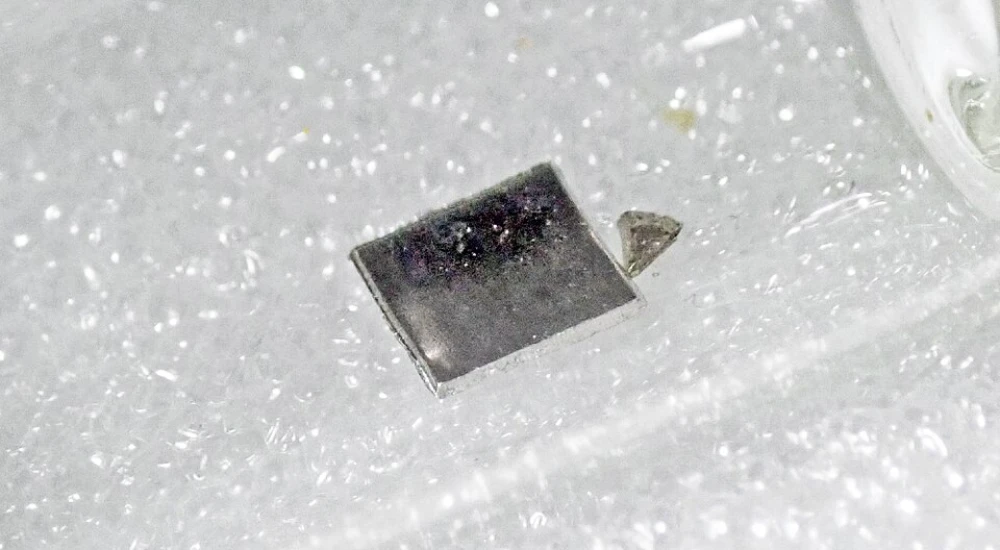
- Reflectivity: Rhodium has superior light and optical reflectivity compared to platinum, which is why it is frequently used to plate white gold and mirrors.

Pure platinum is relatively soft, highly malleable, and ductile, making it easy to shape into wire or jewelry.
In contrast, rhodium is extremely hard and brittle in solid form, requiring initial hot-working during fabrication, though it provides an exceptionally hard protective layer when electroplated.
Chemical Properties
Platinum is one of the least reactive noble metals and resists corrosion across many environments. Rhodium is similarly unreactive with air, water, and most standard acids under normal conditions.
The critical distinction lies in acid resistance. Platinum resists most acids, though it dissolves in aqua regia (a mixture of nitric and hydrochloric acids). Rhodium is highly resistant to strong acids such as nitric acid and is only slightly soluble in aqua regia.
Both metals excel as high-temperature catalysts. Rhodium is exceptionally effective at reducing nitrogen oxides (NOx) in automotive catalytic converters, while platinum is widely used in diesel converters, fuel cells, and chemical synthesis.
Rhodium vs Platinum: Price Comparison and Market Volatility
On price, the rhodium vs platinum gap is exponential: rhodium commands roughly five times platinum’s price and swings far more violently. This disparity stems from rhodium’s extreme scarcity, its tiny market, and its near-total dependence on a single industrial sector, automotive emissions control.
Price Comparison
Rhodium trades around $8,500 to $9,500 per troy ounce, maintaining its status as the world’s most expensive major precious metal.
Meanwhile, platinum trades significantly lower, at around $1,800 to $1,830 per troy ounce. Although it experienced a massive surge earlier in the year to over $2,900, it has since consolidated.
Market Volatility and Drivers
Rhodium has an exceptionally volatile, small market, roughly 32 tons produced annually, which makes it prone to massive price swings. For example, shifting from a deficit to a minor surplus projection can trigger a sudden 10% plunge in just days. Rhodium also has no dedicated futures market, meaning thin liquidity exacerbates both price spikes and crashes.

While still highly volatile compared with gold, platinum acts as a much more stable and liquid asset. Its price swings are heavily influenced by speculative investor profit-taking, interest rate expectations, and structural automotive deficits forecast out through 2030.
Both metals rely heavily on the automotive industry for catalytic converters. However, rhodium is uniquely exposed to stricter emissions legislation and industrial “thrifting”, where manufacturers seek cheaper chemical alternatives such as palladium or lower alloy ratios, which can rapidly alter its demand dynamics.
Industrial Uses of Rhodium and Platinum Across Industries
In practice, the rhodium vs platinum comparison comes down to specialization versus versatility: rhodium dominates gasoline-engine emissions control and high-reflectivity applications, while platinum anchors diesel aftertreatment, chemical synthesis, and electronics.
Here is how the two metals perform across three major industrial sectors.
Automotive Industry
The automotive sector is the largest consumer of both metals.
- Rhodium: Essential for reducing nitrogen oxide (NOx) emissions in catalytic converters, and highly efficient at breaking down dangerous gases in gasoline engines.
- Platinum: Primarily used in diesel catalytic converters to oxidize carbon monoxide and hydrocarbons, and a key component in hydrogen fuel cells.
Chemical and Glass Manufacturing
Both metals perform where extreme heat and corrosive chemistry meet.
- Rhodium: Used as an alloy to reinforce platinum in high-temperature glass manufacturing equipment, preventing corrosion when making liquid crystal displays (LCDs).
- Platinum: Serves as a vital catalyst in the mass production of nitric acid (for fertilizers) and silicone, and is used to make laboratory crucibles due to its high melting point.
Electrical and Electronics
Reliability makes both metals standard choices in electronics.
- Rhodium: Applied as a plating material for electrical contacts and searchlight reflectors because of its high reflectivity and resistance to electrical wear.
- Platinum: Used in hard disk drives to increase storage capacity, as well as in thermocouples for precise temperature measurement.
Partner with Ledoux & Co. for Precise Rhodium and Platinum Analysis
Every rhodium vs platinum decision, settling a spent catalyst lot, valuing electronic scrap, or verifying refined material, depends on assay data you can defend in a transaction.
At Ledoux & Co., we deliver that certainty as an independent, family-owned laboratory with more than 145 years of unbiased metallurgical expertise.
Our Catalyst Testing Expertise
Our catalyst analysis is ISO 17025 accredited, and our assays are commercial-grade, suitable for settlement, umpire use, and quality control. Our capabilities include:
- More than 45 years of accurate PGM analysis for worldwide customers
- Testing of all catalyst types: spent automotive (monolith, diesel, wash coat), spent industrial, reforming, fresh, EO, and VAM catalysts
- Commercial-grade assays that determine the exact palladium, platinum, and rhodium content in spent automotive catalysts
- Assaying of trace gold, silver, platinum, palladium, and rhenium in spent industrial and petrochemical catalysts

Our Accreditations and Standards
We maintain the credentials that make our results commercially defensible worldwide:
- ISO 17025-accredited laboratory (ISO/IEC 17025:2017)
- ISO 9001:2015-certified sampling and analysis
- Affiliate member of LBMA/LPPM and IPMI industry memberships
- NIST-traceable standards and trusted methods for accurate analysis
- Independent, unbiased, family-owned laboratory since 1880
Key Takeaways
The rhodium vs platinum comparison comes down to specialization: rhodium offers extreme scarcity and unmatched NOx-reduction performance, while platinum delivers broader industrial versatility at a lower cost.

For recyclers, refiners, and manufacturers, accurate assay data is the foundation of fair settlement and maximum value recovery. Partner with Ledoux & Co. for ISO 17025-accredited PGM analysis backed by over 145 years of independent, unbiased expertise.
Contact us today or submit a sample to experience the precision that industries worldwide trust.


