
How to identify silver ore begins with a distinction: a promising rock is not confirmed ore until its silver content and recoverability are established. Native silver can appear metallic, but silver also occurs in dark sulfides or within other minerals. Several minerals can share similar colors. Use observations to decide what warrants testing, not to assign a grade.
- Record the location and rock setting, and retain site notes.
- Examine fresh and weathered surfaces under good light.
- Note metallic minerals and vein textures without assuming silver.
- Compare streak and hardness on small areas of fresh grains.
- Check malleability, cleavage, density, and magnetism where safe and practical.
- Separate lookalikes and document uncertainty for each specimen.
- Collect a representative sample for laboratory analysis before estimating grade.
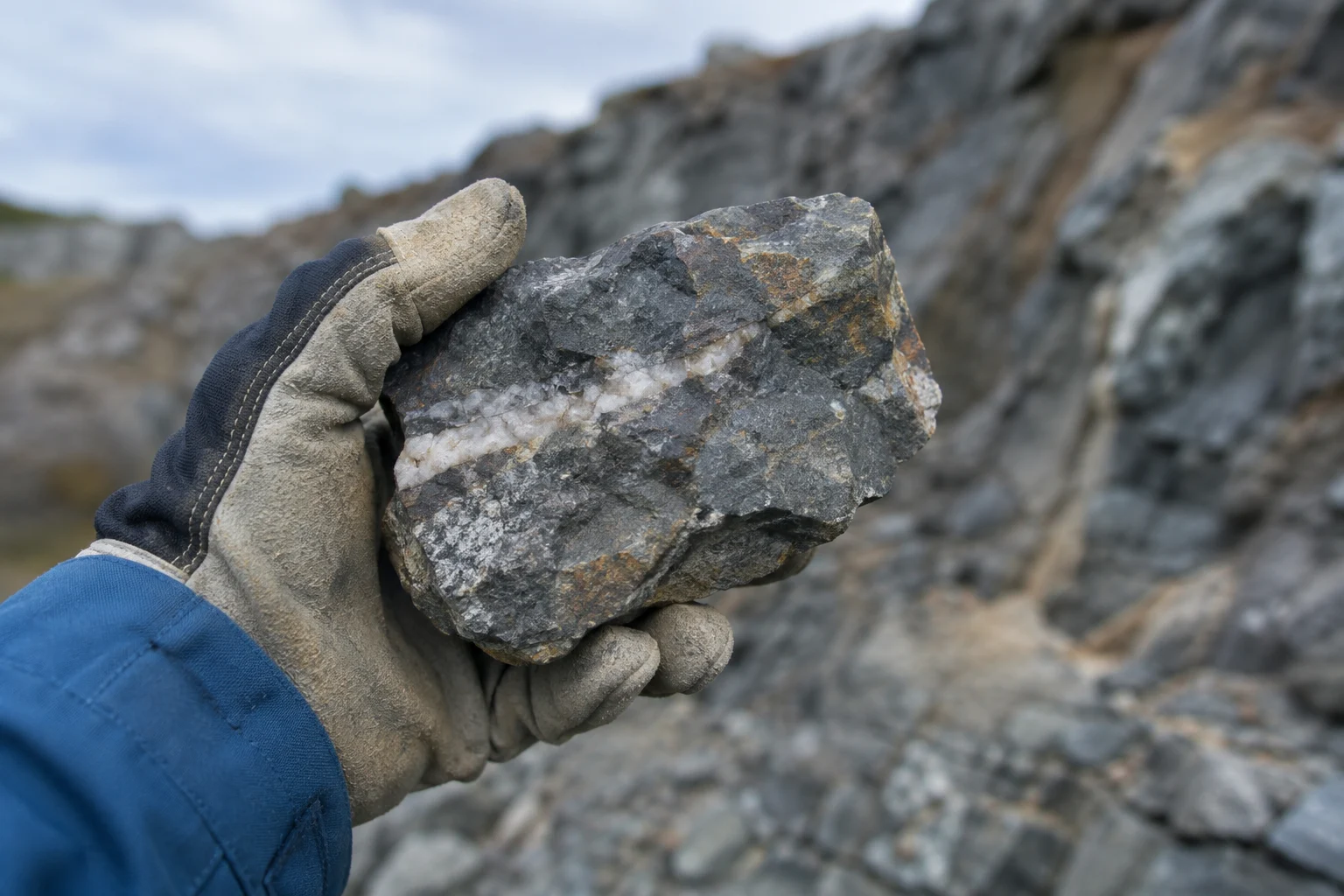
What Does Silver Ore Look Like?
A polished silver color is not the normal appearance of every silver bearing rock. Native silver may form wires, flakes, or irregular masses, but exposed surfaces can tarnish. Acanthite, a silver sulfide, is commonly lead gray to black. Other silver can be dispersed through minerals that look like ordinary lead, copper, or iron sulfides.
Examine both a fresh break and an exposed surface. Record color, luster, grain size, and whether metallic material occurs in veins, patches, or fine specks. A dark rock is not automatically silver ore, and a bright one may contain no silver. When learning how to identify silver ore, appearance helps prioritize samples; it cannot establish the presence, concentration, or commercial value of silver.
Silver Ore Minerals and Where They Form
Silver can occur as native metal, in a distinct silver mineral, or as a minor constituent of another mineral. Geological setting helps narrow possibilities, but the same host rock can contain both mineralized and barren material. Treat every identification as provisional until analysis supports it.
Native Silver vs Silver Sulfides
Native silver is elemental silver, sometimes visible as wires or branching masses. Its metallic appearance and malleability can distinguish it from brittle sulfides, although tarnish may conceal the surface. Acanthite is silver sulfide and can look dark gray or black. The older name argentite is often used for the same composition, but room temperature specimens commonly occur as acanthite.
The difference matters because a dark sulfide need not resemble silver metal to carry silver. Conversely, finding a shiny grain does not prove it is native silver. Preserve a piece for mineral identification and avoid estimating bulk grade from a striking surface feature. U.S. Geological Survey research documents silver in native metal, sulfides, and other minerals.
Associated Minerals and Host Rocks
Silver bearing deposits may include galena, sphalerite, pyrite, chalcopyrite, or silver rich sulfosalts. Quartz and carbonate veins can provide context, as can alteration around the mineralized zone. Galena is a lead sulfide that may carry silver in tiny inclusions, but visually similar galena can contain very different silver amounts.
Map where each specimen came from. Note the host rock, vein orientation, nearby sulfides, and changes along the outcrop or lot. These observations help a geologist select meaningful samples and interpret results. They are associations, not proof: quartz, galena, or dark staining alone cannot establish that a rock contains payable silver.
Field Tests to Identify Silver Ore
Simple field checks compare minerals through several physical properties. Test a small, inconspicuous area and record results rather than declaring an identification. Mixed rocks can produce conflicting clues because a single hand specimen may contain multiple minerals.
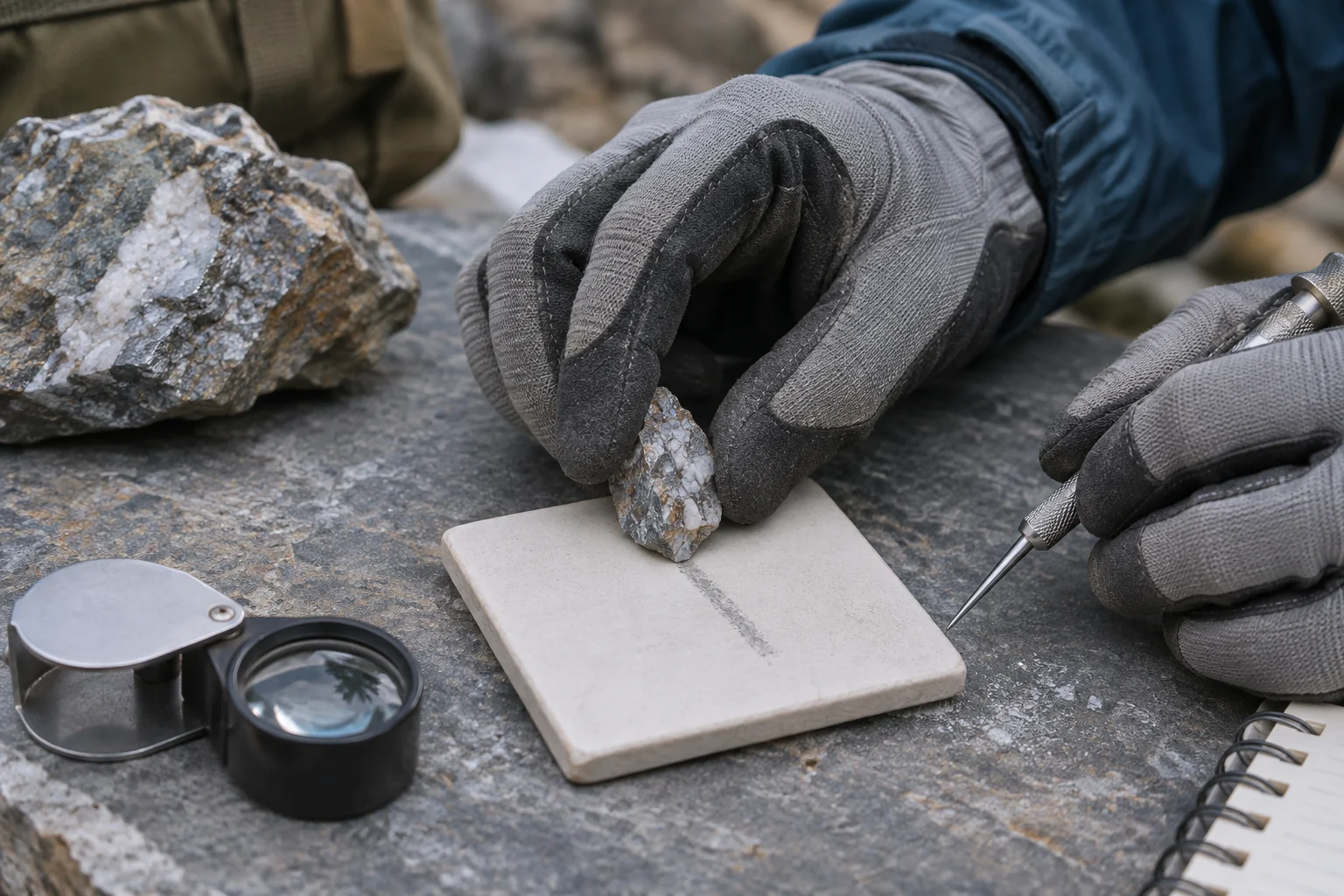
Streak, Hardness, and Malleability
Streak is the color of a mineral’s powder on unglazed porcelain. It can differ from the color of a weathered surface. Compare a fresh grain rather than grinding an entire mixed rock; powder from adjacent minerals can obscure the result.
Hardness describes resistance to scratching, not resistance to breaking. A steel tool may scratch a softer grain, while pyrite is much harder. Native silver can bend or flatten, whereas brittle lookalikes tend to chip or fracture.
Use these observations together. None identifies silver content across a deposit, and scratching a specimen can destroy useful textures if done indiscriminately.
Density, Cleavage, and Magnetism
A heavy specimen may contain dense minerals, but weight alone cannot identify silver. Galena is dense and commonly shows cubic cleavage, meaning it breaks along flat planes meeting at near right angles. That combination points toward galena, not necessarily silver. Acanthite lacks the same obvious cubic cleavage.
A magnet may reveal a magnetic component such as magnetite. No attraction does not confirm silver, and attraction does not rule out silver in a mixed rock. Compare several fresh grains and photograph the results. If minerals are too fine to distinguish, microscopy and laboratory methods are more useful than additional field guesses.
How to Collect Representative Samples for Testing
For a single specimen, label the sample with its location, rock type, and observed minerals. For a larger lot, collect material from multiple positions rather than choosing only the brightest pieces. Keep separate zones or material types separate when they could have different grades.
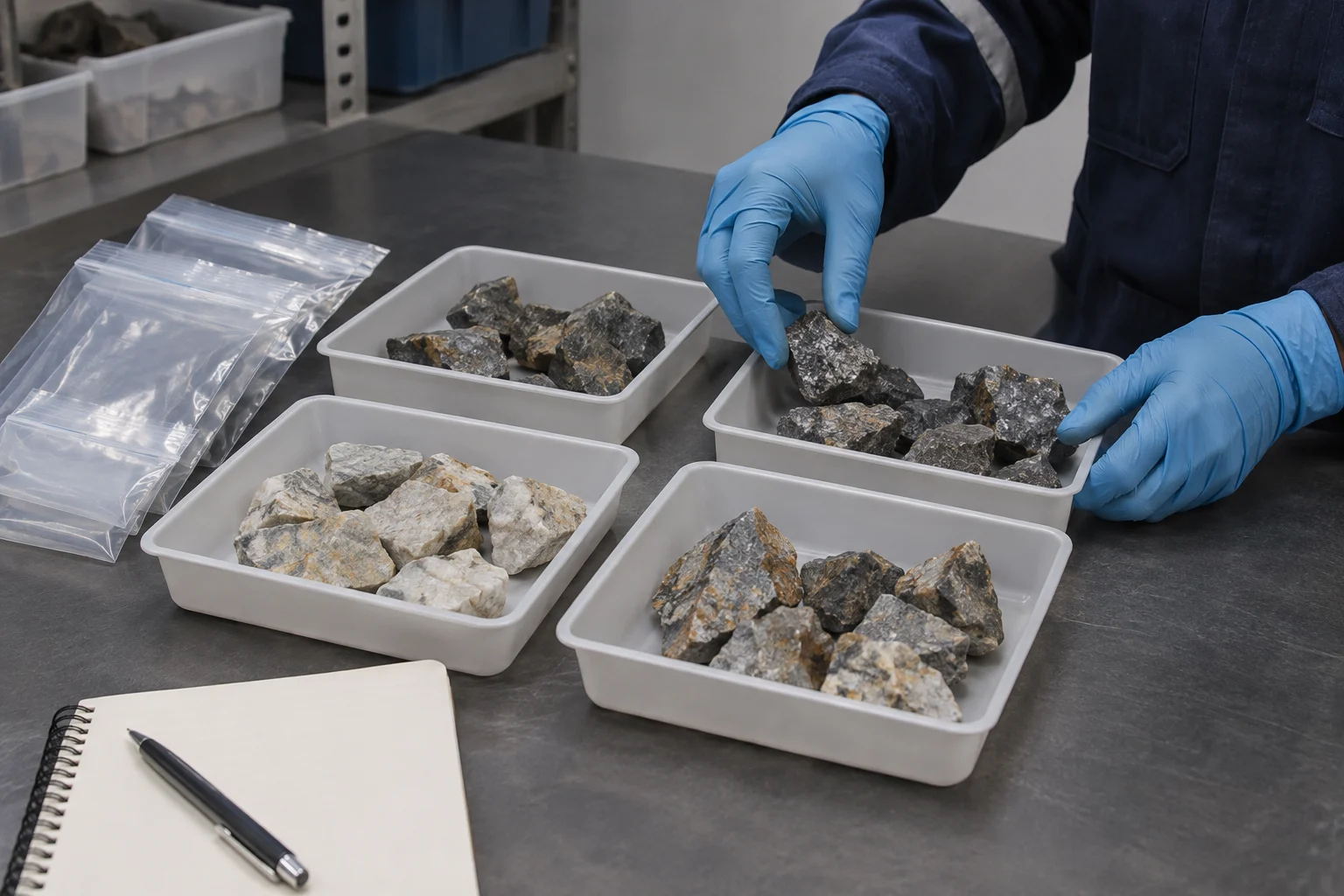
A practical sequence is:
- Define the material and the question the assay must answer.
- Collect increments from across the relevant lot or exposure.
- Combine and prepare material according to the laboratory’s instructions.
- Retain labels and a record of collection, handling, and any split samples.
Ledoux & Co.’s Precious Metals Analysis service covers silver in ores and concentrates. A representative prepared sample can be analyzed with a method suited to the material and reporting need. For more on methods, read how to test gold and silver ore guide. To establish content rather than rely on appearance, Submit a Sample with its description and requested elements.
