
Testing purity of copper by conductivity measurement is a non-destructive method that estimates copper purity based on its electrical resistance. Pure copper offers minimal resistance; as impurities rise, resistance increases and conductivity drops.
While effective for quick field estimations, understanding its limitations is critical for sound business decisions.
Why Pure Copper Is the Gold Standard for Electrical Conduction
Pure copper is the gold standard for electrical conduction because its atomic structure allows electrons to move freely, making it highly sensitive to impurities that increase resistance.
At the atomic level, pure copper possesses a single outer electron that detaches easily to carry electrical current. When we introduce impurities, such as zinc, nickel, or tin, into this copper matrix, they disrupt the uniform lattice.
You can think of these impurities as speed bumps on a highway; they obstruct the smooth flow of electrons, forcing them to scatter and increasing electrical resistance. Because this physical reaction is predictable, measuring this impedance provides a highly accurate inverse estimation of copper purity.
The Equipment Used for Testing Copper Purity via Conductivity
The equipment used for testing purity of copper by conductivity measurement primarily includes Eddy Current testers and Four-Point Probes, both passing electrical currents or magnetic fields into the copper to measure travel ease. These handheld or benchtop tools provide instant readings, making them excellent for quick sorting on the factory floor.
Fabricators and recyclers rely on two distinct non-destructive field methods offering different operational advantages based on sample geometry.
Eddy Current Testing
This method utilizes a probe with a coil generating an alternating magnetic field. The field induces “eddy currents” in the copper, and the material’s purity changes the strength and phase of these currents.
Because it requires no direct contact, eddy current testing is ideal for inspecting finished, coated surfaces like copper wire and tubing, providing immediate results in %IACS.
Four-Point Probe Method
This setup utilizes four equally spaced, collinear pins placed directly on the copper surface. The outer two probes inject a constant electrical current, while the inner two measure the voltage drop.
This method eliminates the contact resistance between the probe and the metal itself, which is crucial for pure copper’s low resistivity, ensuring the reading reflects only the material’s true resistance.
What Is the International Annealed Copper Standard (IACS)?
The International Annealed Copper Standard (IACS) is the universal benchmark used to express electrical conductivity, defining pure, annealed copper as 100% IACS at 20°C to standardize purity estimations.
This standard provides a universally understood language for metallurgists and buyers. It translates complex volume resistivity measurements into a simple percentage, allowing industries to easily interpret conductivity readings regardless of location.
While often cited as 58.00 MS/m, the precise internationally recognized standard (adopted 1913/1914) is 58.001 MS/m, though 58 MS/m or 58.1 MS/m is commonly used in practical applications.
For example, a reading of 101% IACS typically indicates high-purity, oxygen-free copper.; while an 85% IACS reading strongly suggests the presence of alloying elements or heavy impurities within the batch.
The Limitations of Converting Conductivity to Pure Copper Content
Converting conductivity to pure copper content has strict limitations because the relationship between conductivity and purity is not linear, as different trace elements impact electrical resistance at vastly different rates.
Certain trace elements like silver barely affect conductivity even in relatively high amounts due to similar atomic structures.
Conversely, elements like phosphorus drastically reduce conductivity even in minute, trace quantities, skewing linear purity calculations.
A conductivity reading cannot identify which specific impurities are present, it only indicates that foreign elements exist within the metal matrix.
Why Field Conductivity Tests Aren’t Enough for Financial Settlements
Field conductivity tests are not enough for financial settlements because they only test localized surface areas, cannot identify specific impurities, and fail to differentiate pure copper from intentionally deoxidized alloys.
Conductivity meters physically evaluate only a small surface area, easily missing deeper impurities or inconsistencies within large batches.
Furthermore, different impurity combinations can cause the exact same conductivity drop, creating “alloy ambiguity” where you cannot definitively identify the metal’s chemical makeup. This is highly problematic with deoxidized copper, commonly used in plumbing, which contains residual phosphorus that intentionally lowers its conductivity below 100% IACS.
Even though functionally “pure” for its intended use, a field meter flags it as impure. Basing financial transactions or refining payouts solely on field conductivity leads to disputed loads and lost revenue.
A full chemical assay remains the only way to definitively separate pure copper from specialized alloys.
Ledoux & Co.’s ISO 17025 Accredited Copper Concentrates Testing
We provide definitive copper, gold, and silver analysis through our ISO 17025 accredited copper concentrates testing, delivering precise chemical assays that remove the guesswork of physical field estimations.
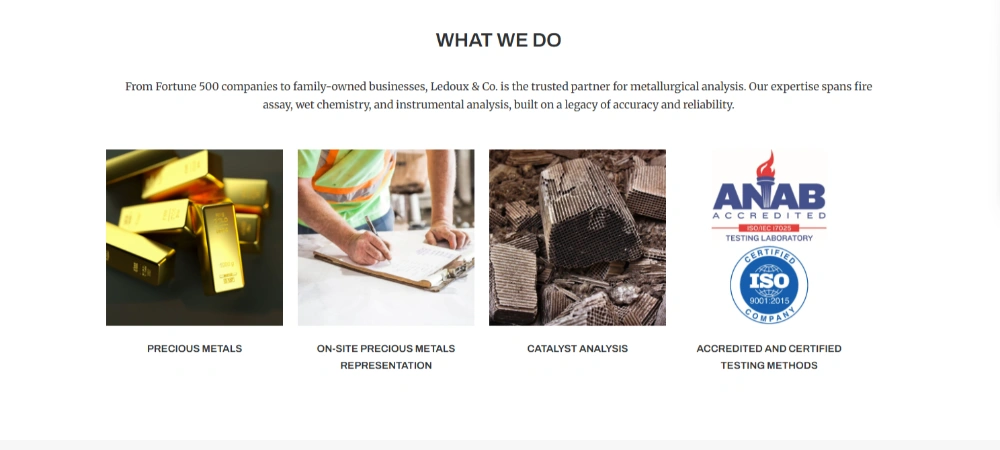
Our comprehensive approach identifies the exact elemental makeup of your materials, ensuring you never overpay for alloyed copper mistakenly assumed to be pure:
- Global Trust: As an LBMA/LPM affiliate, our independent results are trusted globally for commercial-grade financial settlements.
- Advanced Methodology: We utilize wet chemistry and instrumental analysis to identify exact elemental percentages, eliminating the blind spots of conductivity meters.
- Rigorous Certification: Our ISO 17025 accreditation and ISO 9001:2015 certification guarantee strict NIST-traceable quality controls.
- Precision Sampling: We require a properly prepared sample, typically 100 grams of 70-mesh ground material, to ensure results accurately represent the entire lot.
- Historical Expertise: Since 1880, our independent lab has delivered unbiased, scientific truth for Fortune 500 companies and family-owned businesses alike.
- Unbiased Representation: We treat your material like our own, ensuring you get the greatest return on your investment with zero external influence.
Key Takeaways
Relying solely on physical conductivity estimations creates significant business risks due to alloy ambiguities and the inability to identify specific impurities. While testing purity of copper by conductivity measurement is valuable for fast sorting, it cannot replace definitive chemical analysis.

At Ledoux & Co., we provide the ISO 17025 accredited assays required to secure your financial settlements and maximize your investment.
Partner with us today to ensure you get the greatest return on your investment.