
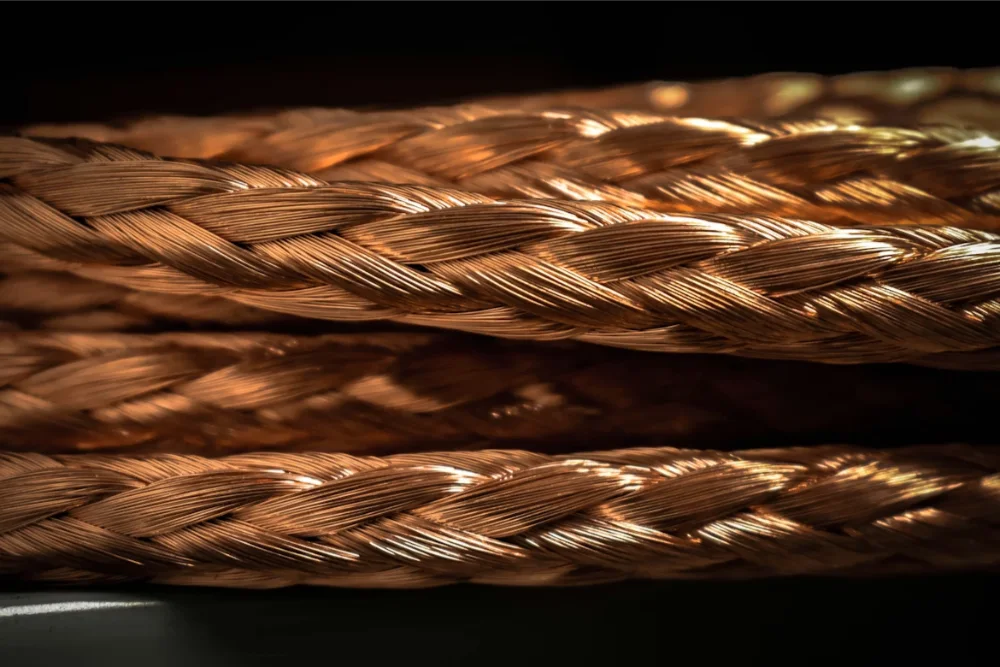
Copper ore types are primarily classified into sulfides, oxides, and native copper, with each category dictating specific extraction methods and byproduct potential.
This raw, unrefined rock fuels global manufacturing and electronics, but recognizing the exact mineralogy is critical for determining processing routes and unlocking hidden value like gold and silver.
How Geologists Classify Copper Ore Types
Geologists classify copper ore types by chemical composition, specifically, whether copper bonds with sulfur or oxygen.
- Sulfide ores (copper bonded with sulfur) account for roughly 80% of global copper production.
- Oxide ores (copper bonded with oxygen) comprise the remaining output, typically capping deeper sulfide deposits.
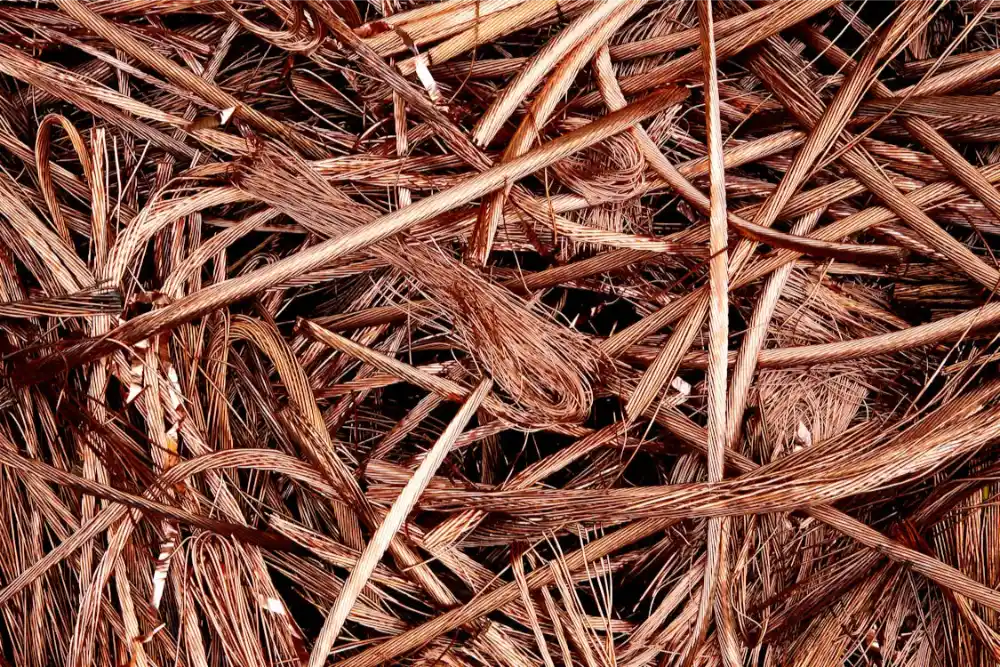
The specific classification fundamentally dictates the metallurgical process, forcing a strict choice between pyrometallurgy (smelting) for sulfides and hydrometallurgy (leaching) for oxides.
Identifying these distinctions early in the exploration phase prevents costly processing errors and ensures the correct refining infrastructure is utilized for the deposit.
Sulfide Copper Ore Types
Sulfide minerals represent the backbone of the global copper mining industry, characterized by their complex crystalline structures. Identifying the specific sulfide mineral is the first critical step in designing an efficient, cost-effective processing plant.
Chalcopyrite: The Most Abundant Copper Ore Type
Chalcopyrite (CuFeS2) stands as the most abundant and widely mined copper ore type globally. Recognizable by its brassy yellow appearance, it is historically notorious for being mistaken for gold, earning the moniker “fool’s gold.”
Despite its sheer abundance in the earth’s crust, chalcopyrite possesses a relatively lower copper content compared to secondary minerals.
Consequently, refiners must process chalcopyrite through energy-intensive pyrometallurgy, utilizing high-temperature smelting to successfully separate the copper from the intertwined iron and sulfur matrices.
Secondary Sulfide Copper Ore Types: Chalcocite and Bornite
Secondary sulfides form when primary sulfides undergo weathering and chemical enrichment near the Earth’s surface. These minerals are highly sought after by smelters because their unique chemistry requires significantly less energy to process than chalcopyrite.
- Chalcocite (Cu2S) is a highly valuable, high-grade copper ore type, containing up to nearly 80% pure copper by weight.
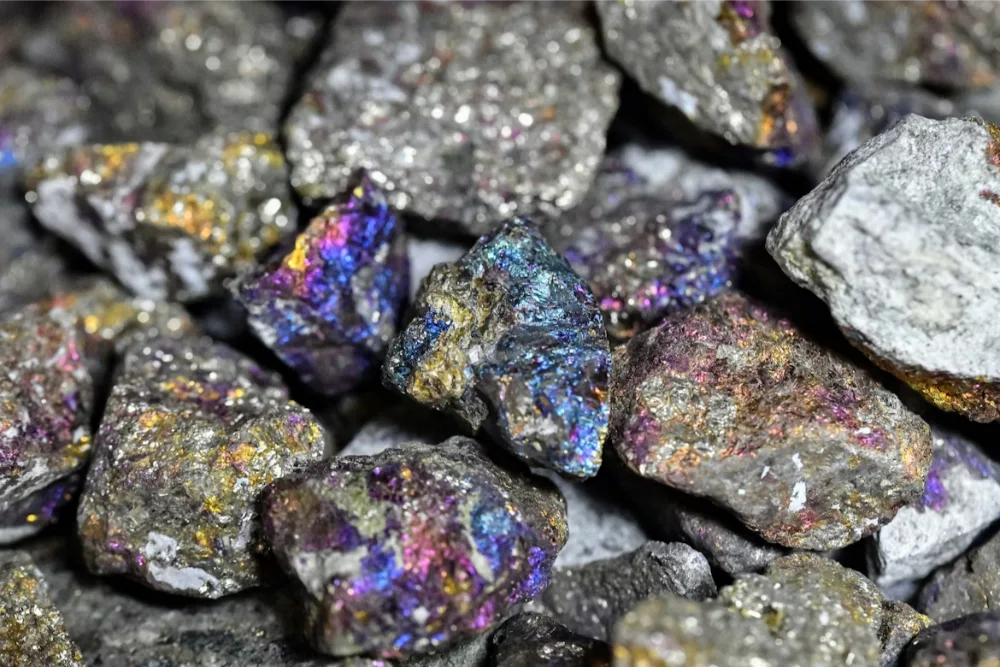
- Bornite (Cu5FeS4) is easily identifiable by its iridescent purple-blue oxidation colors, leading to its popular name, “peacock ore.”
Oxide Copper Ore Types
Oxide minerals develop when prolonged exposure to oxygen and groundwater weathers primary sulfide deposits near the surface. These ores demand an entirely different chemical extraction approach than their sulfide counterparts.
Malachite and Azurite: Recognizable Oxide Copper Ores
Because these ores contain oxygen rather than sulfur, they cannot be efficiently smelted. Instead, refiners rely on hydrometallurgy, utilizing sulfuric acid leaching followed by Solvent Extraction and Electrowinning (SX-EW) to extract pure copper cathodes.
- Malachite (Cu2CO3(OH)2) is a bright green carbonate mineral that serves as one of the most visually distinct copper ore types in the field.
- Azurite (Cu3(CO3)2(OH)2) presents as a deep blue carbonate mineral and is almost exclusively found geologically adjacent to malachite deposits.
Cuprite: High-Grade Oxide Copper Ore
Cuprite (Cu2O) is a simple copper oxide mineral distinguished by its striking deep red color and remarkable purity.
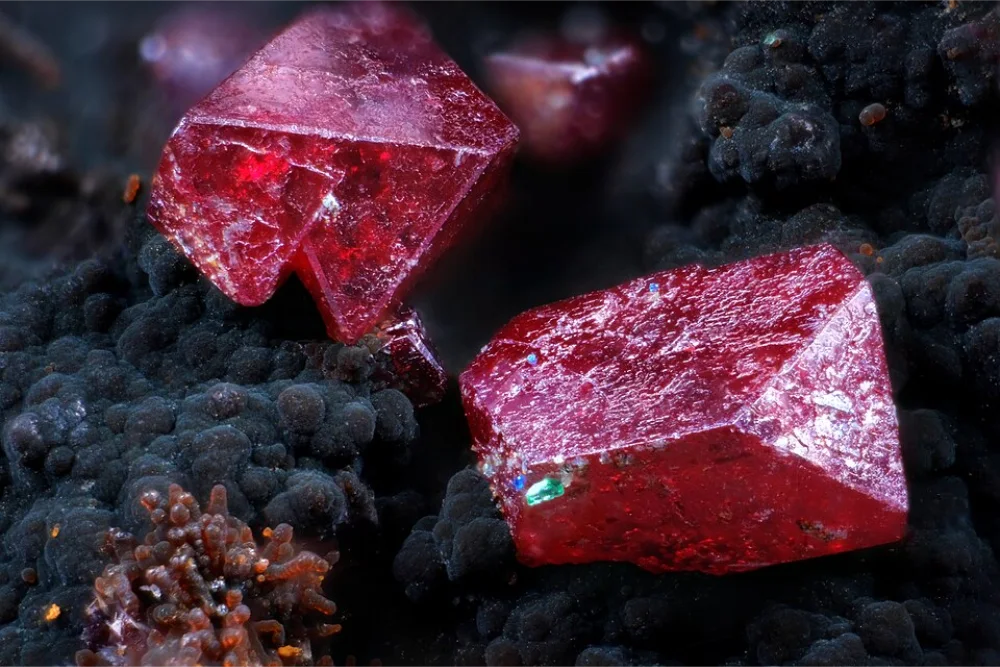
Boasting a copper content of up to 88.8%, cuprite is highly profitable when discovered in large quantities, though it remains less common than malachite.
Like other oxide copper ore types, cuprite is highly soluble in sulfuric acid, establishing it as an exceptional and efficient candidate for modern leaching operations and SX-EW processing.
How Copper Ore Types Impact Processing and Profits
The profitability of a mining operation is directly tied to its copper ore types because mineralogy dictates processing costs and precious metal byproducts.
Native copper (pure metallic copper) is extremely rare in modern commercial mining, with sulfide and oxide minerals dominating production. Today, sulfide and oxide minerals dominate production, carrying “hidden value” that often dictates a project’s financial viability.
Trace amounts of gold and silver are frequently locked inside sulfide ores, providing essential revenue streams that offset high refining costs.
With copper prices exceeding $13,000 per tonne and Treatment Charges/Refining Charges (TC/RCs) plunging to zero in certain markets, these precious metal byproducts are absolutely crucial for smelter survival.
Furthermore, the sulfur extracted from sulfide processing is converted into sulfuric acid, creating another valuable byproduct for the chemical industry.
Accurately quantifying precious metals and complex mixed-ore chemistry requires expert, independent laboratory analysis to determine if a deposit is commercially viable.
Accurate Copper Concentrates Testing With Ledoux & Co.
Regardless of the copper ore types processed, the raw material eventually becomes a concentrate requiring precise assaying.
Our Copper Concentrates Testing service delivers the definitive analytical data needed for high-stakes financial transactions. Simply relying upon a superficial XRF reading is not nearly enough to uncover the true value of these complex materials.
We require exactly 100 grams of 70-mesh ground material to ensure a perfectly homogeneous, representative sample. From there, we don’t just test for copper content; we simultaneously analyze the material for the gold and silver byproducts often contained within, helping refiners and recyclers maximize their return on investment.
As an independent, ISO 17025 accredited and ISO 9001:2015 certified lab, as well as a proud affiliate member of the LBMA/LPM, we provide commercial-grade assays trusted for global financial settlements. These prestigious credentials signify our commitment to quality, competence, and reliability at the highest industry levels.
With over 145 years of experience since 1880, we treat your materials like our own. We utilize strict NIST-traceable standards to deliver unbiased, scientific truth in every report we issue.
Key Takeaways
The core challenge in copper processing is that misidentifying copper ore types leads to severe financial losses and metallurgical inefficiencies. Sulfide, oxide, and native copper ores each require highly specific extraction processes, ranging from intensive smelting to chemical leaching.

Accurate classification and precise assaying are the only ways to unlock hidden precious metal values and ensure correct refining.
Partner with Ledoux & Co., where our ISO 17025 accredited lab delivers precise, unbiased analysis to protect your financial interests. Contact us today for commercial-grade results.


